Pickleball Injury Chiropractor NYC for Recovery
A pickleball injury chiropractor NYC players choose should look beyond the sore spot and assess how your spine, joints, movement patterns, and nervous system are handling the demands of the game. The goal is not simply to get you back on the court quickly. It is to help you return with better control, confidence, and a plan to stay active.
Pickleball looks friendly from the outside. The court is compact, the paddle is light, and a game can begin as a casual outing with friends. But quick lateral steps, sudden stops, reaching for a low ball, twisting through a forehand, and looking up for lobs can expose a problem that has been building for years.
At New York Chiropractic Life Center on the Upper West Side, we see this pattern often: an active New Yorker who feels generally fit develops sharp low-back pain, sciatica, neck stiffness, a shoulder complaint, or knee pain after an ordinary point. The match may have been the trigger, but it is not always the whole cause.
Why does pickleball cause injuries?
Pickleball asks the body to move in ways daily life rarely does. You may rotate rapidly, shift weight onto one leg, reach outside your base of support, then stop before the kitchen line. Those demands can be difficult when spinal motion is limited, core control is poor, old injuries have changed your mechanics, or recovery has not kept pace with activity.
The most common complaints we hear include low-back pain, disc irritation, sciatica, neck pain, shoulder pain, hip and knee discomfort, Achilles irritation, and calf or hamstring strains. A fall can also lead to a wrist, rib, or shoulder injury that needs prompt medical evaluation.
Age is not the problem. A 65-year-old who maintains strength, mobility, balance, and good movement habits may play comfortably for decades. A 45-year-old with an unaddressed disc issue or weak single-leg stability may be more vulnerable. This is the 100 Year Lifestyle in practical terms: build a body that supports the life you want to keep living.
When should you see a pickleball injury chiropractor in NYC?
Pain that changes how you walk, sleep, work, or play deserves attention. So does pain that returns every time you serve, reach, bend, or rotate. Waiting until a minor ache becomes a month away from the court is rarely the best strategy.
For back or neck symptoms, pay close attention to pain that travels into the buttock, leg, arm, hand, or foot. Numbness, tingling, burning, weakness, or a feeling that one leg will not cooperate can point to nerve involvement. A disc bulge or herniation is not the only possible explanation, but these signs call for a thorough examination rather than guesswork.
Some situations require urgent medical care instead of waiting for an office visit. Seek immediate evaluation after a significant fall, obvious deformity, inability to bear weight, rapidly worsening weakness, loss of bowel or bladder control, or numbness in the groin area. Those symptoms need prompt medical assessment.
Why can a back injury show up during a simple game?
Many players are surprised when low-back pain or sciatica begins during a routine shot. They did not collide with anyone. They did not lift a heavy box. They simply lunged, rotated, and felt something catch.
Often, the body has been compensating for a while. Long hours at a desk, subway rides, old running injuries, reduced hip motion, or a previous episode of back pain can all change how force moves through the body. One fast rotation may be enough to aggravate a sensitive joint, disc, or nerve.
This is why we do not reduce every pickleball injury to a tight muscle. Massage can be helpful for muscular tension, and rest can settle an irritated area, but neither automatically addresses the reason the same movement keeps provoking symptoms. The right approach depends on the exam findings, your history, and what your body can tolerate now.
What does chiropractic care for pickleball injuries involve?
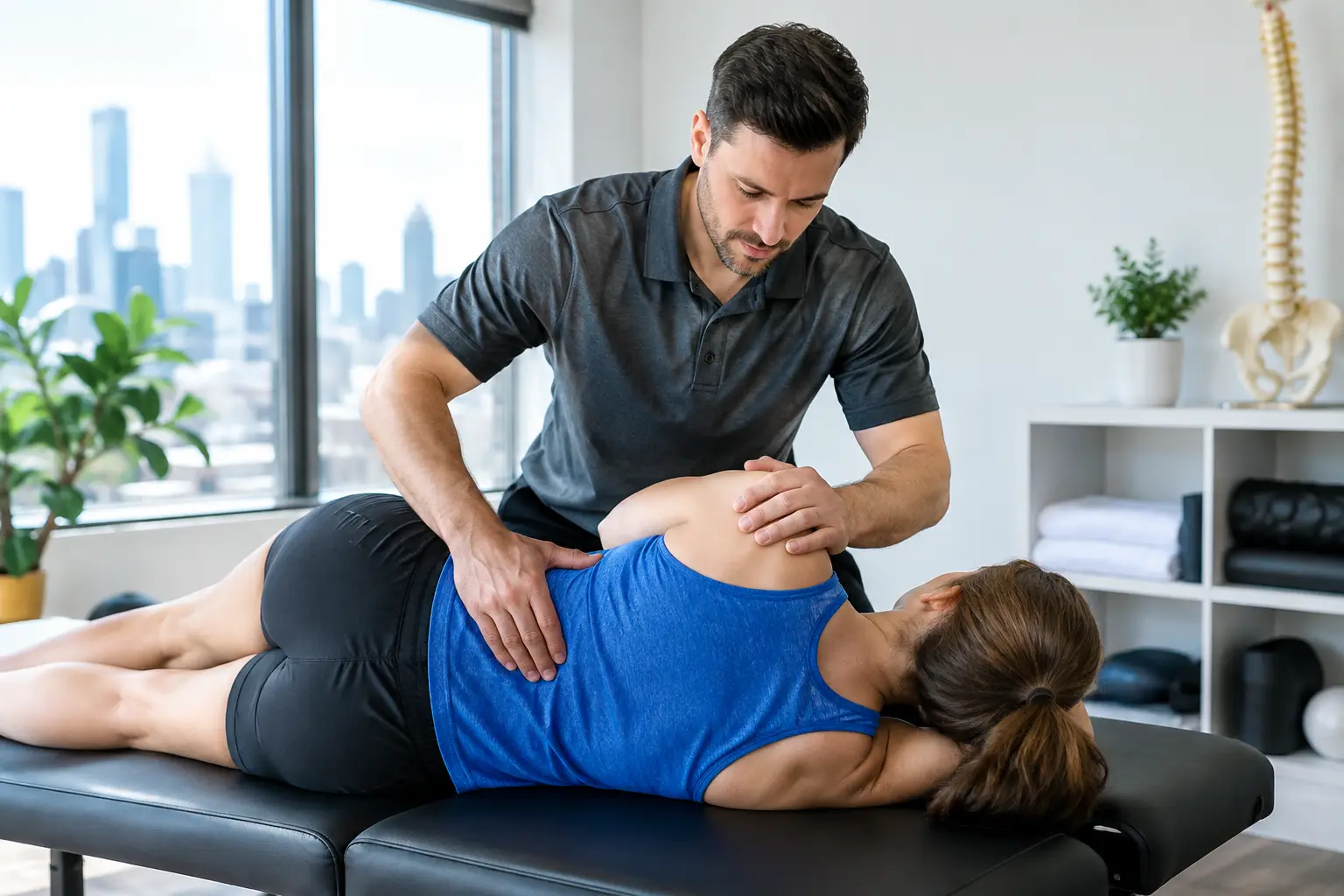
Sports and athlete performance care at our Upper West Side New York City practice begins with understanding the person, not just naming the painful area. We want to know what happened during the game, whether symptoms travel, what movements are limited, how long the problem has been present, and what you need to return to.
A careful assessment may include posture, range of motion, neurological findings, balance, gait, and movement patterns such as rotation, squatting, or stepping. When appropriate, digital imaging and additional evaluation help us understand the spine more clearly. Dr. Josh Handt, DC, CFNMP, and Dr. Jay Handt use those findings to determine whether corrective chiropractic care, soft-tissue work, guided movement recommendations, massage therapy, or another path is appropriate.
For a player with disc-related pain or sciatica, the conversation may include non-surgical spinal decompression. This is a controlled, computer-guided approach designed to gently change pressure within spinal discs. It is not appropriate for every person or every type of back pain, which is why an accurate assessment matters first.
We have cared for more than 50,000 patients over 65-plus years in practice. Experience teaches a useful lesson: the best plan is rarely the most aggressive plan. It is the plan that matches the injury, respects the nervous system, and progresses as function improves.
What should you do in the first few days after a pickleball injury?
Do not try to prove toughness by playing through sharp pain, radiating symptoms, or a limp. At the same time, complete inactivity can leave you stiffer and more guarded. The right amount of rest depends on the injury.
For a mild strain, short walks and comfortable movement may be better than spending a weekend on the couch. For a swollen ankle, a fall, or significant pain with weight-bearing, protecting the area and getting evaluated is more sensible. Avoid repeatedly testing the painful motion just to see whether it still hurts.
Notice the details that help a clinician make better decisions: what movement caused the pain, whether symptoms spread, what positions ease or worsen it, and whether you have had a similar episode. Those facts are more useful than calling everything a pulled muscle.
How can you return to pickleball without repeating the injury?
Returning well is different from returning fast. A player whose pain has quieted but still cannot rotate, step laterally, or balance on one leg without compensation is not fully prepared for a competitive game.
Start with purposeful practice rather than a two-hour session. Hit gently, avoid chasing difficult balls at first, and stop before fatigue changes your mechanics. Build from controlled drills to short games, then increase frequency or intensity one variable at a time. If you add both more games and harder games in the same week, it becomes difficult to know what your body is tolerating.
Good preparation is not a complicated biohacking project. It is consistent sleep, basic strength, mobility that supports your game, balance, hydration, and recovery. For many New Yorkers, the biggest upgrade is scheduling movement before the calendar gets crowded, not buying another gadget.
Footwear matters too. Court shoes with lateral support may be a better fit than worn running shoes for players who make frequent side-to-side cuts. But shoes cannot compensate for poor balance, a weak hip, or an irritated nerve. Equipment is helpful. Movement capacity is foundational.
FAQ about pickleball injuries and chiropractic care
Can chiropractic care help sciatica from pickleball?
It may help when the examination shows a mechanical spinal or nerve-related component that is appropriate for chiropractic care. Sciatica has several possible causes, so the first step is determining what is creating the symptoms and whether additional medical evaluation is needed.
Should I stop playing pickleball if my back hurts?
Stop playing and get assessed if pain is sharp, radiates, causes weakness or numbness, or alters your gait. For mild, localized soreness, temporary activity modification may be enough, but persistent or recurring pain should not be ignored.
Is non-surgical spinal decompression right for every back injury?
No. Non-surgical spinal decompression is used selectively for qualifying disc-related conditions, including some cases of herniated discs, bulging discs, and sciatica. A full assessment determines whether it fits your condition and health history.
How can older adults keep playing pickleball safely?
Focus on balance, leg strength, spinal mobility, gradual conditioning, and recovery. Play at an intensity that matches your current capacity, especially after a break, illness, travel, or a previous injury.
Pickleball should add energy and connection to your week, not make you afraid of the next step or swing. If pain is limiting the way you move or the activities you enjoy, Book Your Spinal Blueprint Assessment. It is a comprehensive spine and nervous system assessment at New York Chiropractic Life Center on the Upper West Side of New York City, designed to clarify what is going on and what your next step should be.
Dr. Josh Handt, DC, CFNMP, Chiropractor and Functional Health