Non Surgical Spinal Decompression NYC Care
Non surgical spinal decompression NYC care may be a thoughtful option for people with certain disc-related back pain, leg pain, or sciatica who want to pursue a drug-free, non-operative approach. At New York Chiropractic Life Center on the Upper West Side of New York City, we first determine whether your symptoms, history, and spinal findings make decompression an appropriate part of care.
A disc problem can make ordinary New York life feel much smaller. Walking to the subway, sitting through a workday, carrying groceries, playing tennis, or getting out for a Central Park run can become calculations around pain. The goal is not simply to get through the next few days. It is to help you reclaim confident movement and protect your ability to stay active for decades.
What is non surgical spinal decompression?
Non-surgical spinal decompression is a form of computer-guided traction designed to gently cycle between pulling and relaxation forces along the spine. For a person with a bulging disc, herniated disc, or nerve irritation, this approach may help reduce mechanical pressure around an affected spinal segment while supporting the disc’s exchange of fluids and nutrients.
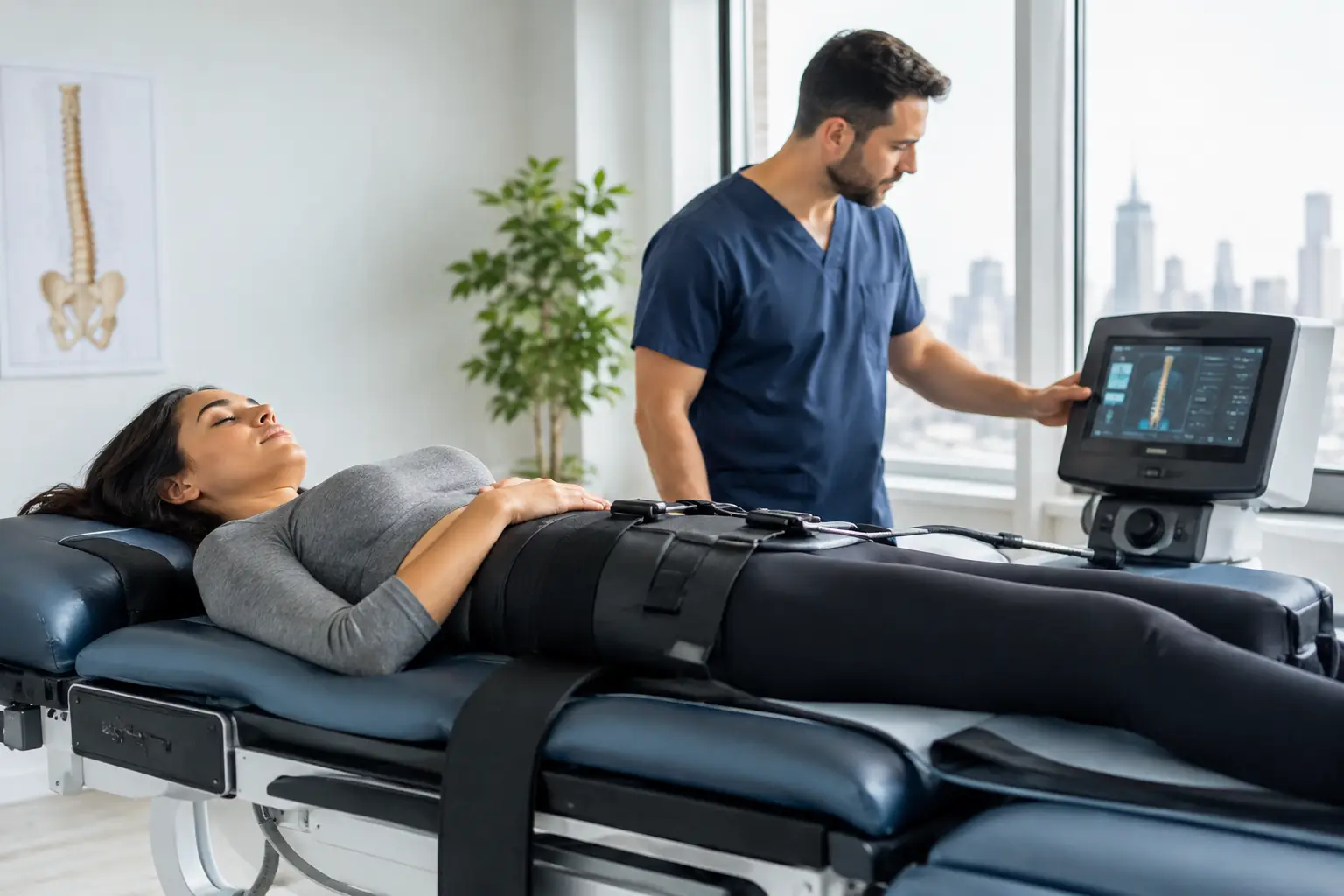
It is not a forceful adjustment, and it is not surgery. During treatment, the patient lies comfortably on a specialized table while the system applies carefully controlled traction. Many people describe the sensation as a gradual stretch or a gentle release through the low back.
At New York Chiropractic Life Center, non-surgical spinal decompression on the Upper West Side is not treated as a stand-alone shortcut. Disc symptoms involve more than one structure. Muscles may be guarding, joints may not be moving well, posture can increase repeated stress, and the nervous system may remain highly reactive after weeks or months of pain. Our team looks at the entire pattern.
Who may benefit from spinal decompression in NYC?
People often come to us after a flare-up that has not settled with rest, stretching, medication, or simply waiting it out. They may have low-back pain that travels into the buttock or leg, numbness or tingling, pain when sitting, or a sharp catch when bending and twisting.
Non-surgical spinal decompression may be considered for people with:
- Bulging, protruding, or herniated discs
- Sciatica or radiating leg pain related to disc irritation
- Degenerative disc changes with persistent mechanical pain
- Chronic low-back or neck pain that has not responded to basic self-care
- Recurring symptoms that interfere with walking, exercise, sleep, work, or travel
That does not mean decompression is right for every diagnosis. Severe osteoporosis, certain spinal fractures, spinal instability, some surgical histories, active cancer, infection, and other conditions can change what care is appropriate. Progressive weakness, loss of bowel or bladder control, or numbness in the groin area requires urgent medical evaluation.
The right question is not, “Can this machine fix every kind of back pain?” It cannot. The better question is, “What is driving my symptoms, and is decompression a sensible part of a larger plan?”
Does spinal decompression work for sciatica?
Sciatica describes symptoms, not a single diagnosis. It often includes pain, burning, tingling, or numbness that travels from the low back into the buttock and leg. A disc can irritate a nerve root, but hip problems, joint dysfunction, spinal narrowing, and other issues may create similar symptoms.
When sciatica is related to a disc problem and the examination supports it, spinal decompression can be a useful conservative option. By reducing loading through a painful segment, it may help some patients tolerate movement better and make progress with corrective chiropractic care, mobility work, and daily activity changes.
Results vary because people vary. The size and location of a disc injury, the duration of symptoms, overall conditioning, work demands, sleep, and consistency with care all matter. We do not promise that every person will avoid injections or surgery. We do believe people deserve a thorough, non-surgical evaluation before assuming those are their only paths forward.
What does treatment feel like and how long does it take?
A decompression session is generally calm and comfortable. You are secured with supportive straps, positioned on the table, and monitored as the treatment cycles through gentle traction and release. Some patients feel relief during the session. Others notice change more gradually as irritation settles and movement improves.
Care plans are individualized. A recent flare-up in an otherwise healthy, active person is different from years of recurring pain, multiple injuries, and significant stiffness. Your plan may include decompression sessions along with chiropractic adjustments, movement recommendations, and strategies for sitting, lifting, walking, or returning to training.
This combination matters. If pain improves but the movement and loading habits that contributed to the problem never change, symptoms may return. Our objective is not to make you dependent on appointments. It is to help you build a stronger foundation for the next decade of your life.
Why does a thorough spine assessment matter?
A person can have an MRI finding and still need a careful clinical examination. Disc bulges are common, particularly as we get older, and not every bulge causes pain. Conversely, a person with severe leg symptoms may need prompt co-management or referral even if they have tried conservative care before.
At New York Chiropractic Life Center in New York City, Dr. Josh Handt, DC, CFNMP, Dr. Jay Handt, and our team look beyond the location of pain. We assess spinal motion, posture, neurologic signs, functional movement, health history, and when indicated, digital imaging. That process helps us identify whether decompression is appropriate, whether another conservative approach makes more sense, or whether you should be referred for additional medical evaluation.
This is especially valuable for active adults who have learned to push through discomfort. A runner may call it a tight hamstring when the issue is nerve irritation. A golfer may blame a swing flaw when a disc injury is limiting rotation. A retired New Yorker may stop walking farther from home because leg pain appears after a few blocks. Those are not failures of willpower. They are signals worth understanding.
With more than 65 years in practice, over 50,000 patients served, and recognition through Disc Centers of America Top Doctor, New York Chiropractic Life Center brings long-term clinical perspective to these decisions. We are interested in the outcome that matters outside the office: walking confidently, training consistently, traveling comfortably, and staying independent.
How can you protect your back while recovering?
The first weeks of a disc flare-up are usually not the time to test your limits with aggressive stretching, heavy lifting, or a heroic workout. Relative rest does not mean bed rest. It means choosing movement that your body can tolerate and gradually building capacity.
Walking is often helpful when it does not increase leg symptoms. Short, frequent walks may be more useful than one long outing. Changing positions regularly can also reduce the sustained loading that makes sitting painful. For people who work at a desk, a simple schedule of standing, walking briefly, and resetting posture can make a meaningful difference.
We also encourage patients to think beyond symptom management. The 100 Year Lifestyle is about maintaining a spine and nervous system that can support the life you want at 70, 80, and beyond. That includes strength, mobility, balance, recovery, and the confidence to keep participating in the activities you enjoy.
Frequently asked questions about non-surgical spinal decompression
Is non-surgical spinal decompression painful?
Most people find it comfortable. The treatment uses controlled, gradual traction rather than abrupt force. If a position or level of pull causes discomfort, our team adjusts the setup.
Can I receive chiropractic care and decompression together?
Often, yes. For the right patient, chiropractic care can help restore motion and address joint restrictions while decompression targets disc-related mechanical stress. Your plan should be based on your examination findings, not a preset package.
Can I exercise with a herniated disc?
Usually, some form of movement is appropriate, but the type and amount depend on your symptoms. Walking and carefully selected rehabilitation exercises may help, while heavy lifting, deep bending, twisting, or high-impact training may need to wait. We guide patients back to activity progressively.
How do I know whether my pain is serious?
Persistent pain, pain traveling into the arm or leg, numbness, weakness, balance changes, or symptoms that are worsening deserve an evaluation. Emergency symptoms such as bowel or bladder changes, saddle numbness, or rapidly progressive weakness require immediate medical attention.
If back pain or sciatica is shrinking your world, your comeback can start with clear answers. Schedule a Spinal Blueprint Assessment at New York Chiropractic Life Center on the Upper West Side of New York City for a comprehensive evaluation of your spine, nervous system, movement, and options for care. The next useful step is not guessing what your body needs. It is understanding it well enough to move forward with confidence.