
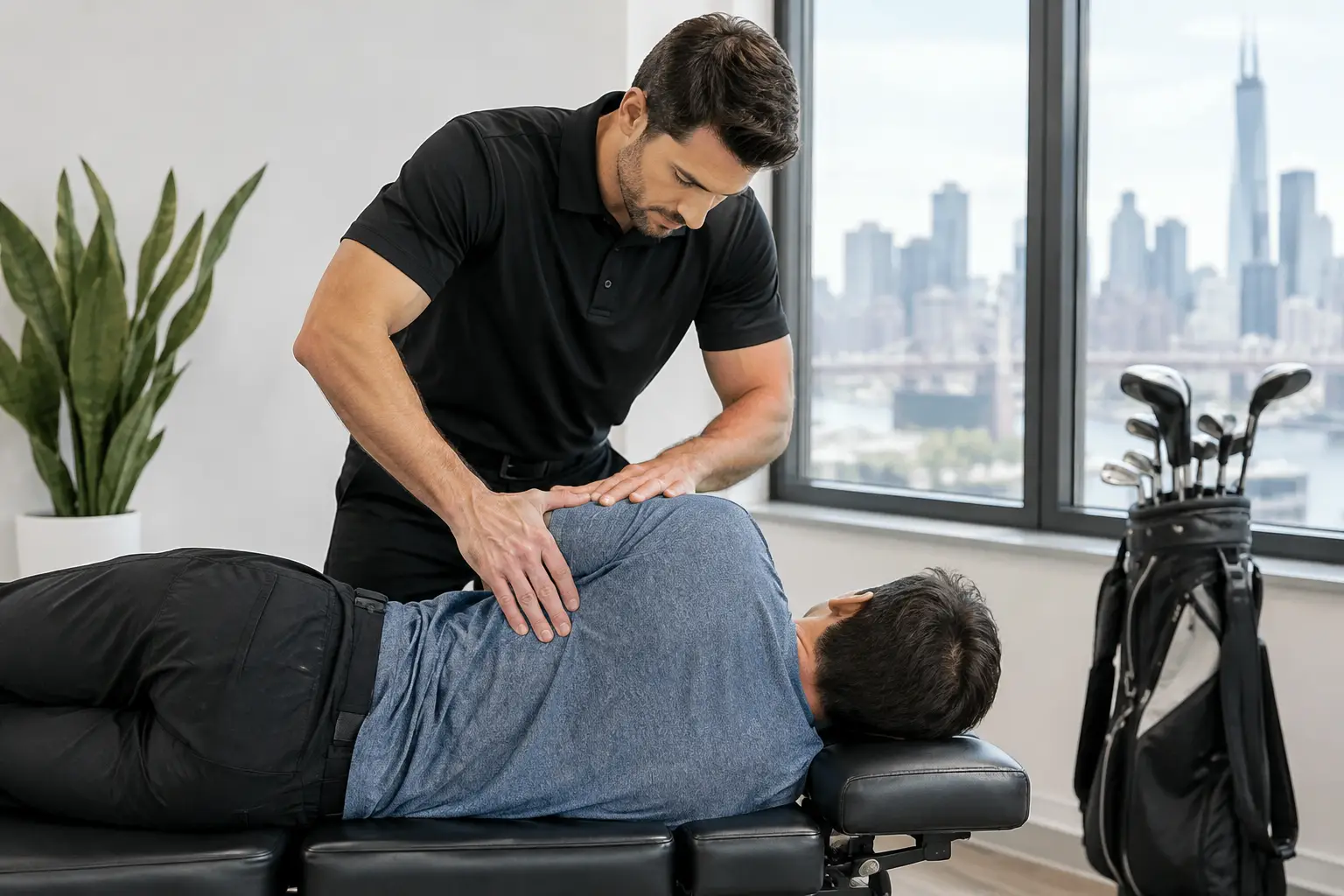
Golf Performance Chiropractor NYC for Better Play
A golf performance chiropractor NYC players choose should do more than chase the sore spot after a round. The goal is to help your spine, hips, shoulders, and nervous system work together so you can swing with greater freedom, train consistently, and enjoy the game for years.
At New York Chiropractic Life Center on the Upper West Side of New York City, we work with golfers who want to keep playing without relying on a cycle of medication, inactivity, and repeated flare-ups. Whether you play nine holes on weekends or compete seriously, your body needs enough mobility, stability, and recovery capacity to handle the demands of the golf swing.
Why does golf cause back pain and stiffness?
Golf looks smooth, but it places significant rotational and compressive demand on the body. A full swing asks your feet to stay grounded while your hips, pelvis, thoracic spine, shoulders, and neck rotate at different speeds. When one area lacks motion or control, another area often absorbs the stress.
For many golfers, the lower back becomes that compensation point. Limited hip rotation can force the lumbar spine to rotate more than it is built to handle. Stiffness through the middle back can make the shoulders work harder. A restricted neck can affect posture, visual tracking, and comfort through the finish.
Pain does not always begin with one dramatic swing. It may build after years of sitting at a desk, commuting, carrying stress in the shoulders, and playing through small warning signs. Then one round, one range session, or one awkward shot from the rough is enough to bring symptoms to the surface.
Common golf-related complaints include low back tightness, pain that travels into the buttock or leg, neck stiffness, shoulder irritation, and a feeling that one side simply cannot turn as far as the other. These symptoms deserve attention, especially when they change how you address the ball or cause you to avoid your normal activities.
What does a golf performance chiropractor in NYC evaluate?
Good sports care starts with understanding the person in front of us, not assuming every golfer has the same problem. At New York Chiropractic Life Center, Dr. Josh Handt and Dr. Jay Handt look at how the spine and nervous system are functioning, along with the movement patterns that may be affecting your game.
We consider your health history, current symptoms, prior injuries, training schedule, work posture, and goals. A golfer trying to finish 18 holes comfortably has different needs from a player preparing for a member-guest event or working to add clubhead speed.
Your evaluation may identify patterns such as restricted spinal motion, poor hip mobility, uneven loading, or irritation associated with a disc problem. If pain travels below the knee, numbness or tingling is present, or symptoms worsen with coughing, sitting, or bending, a more detailed examination is particularly important. Those signs can point to nerve involvement and should not be dismissed as ordinary golf soreness.
The assessment also helps us determine whether chiropractic care is appropriate and what type of care may best support your goals. There is no value in forcing a standard program onto every player. The right plan depends on whether your primary issue is pain, a recurring injury, reduced mobility, or a combination of all three.
Can chiropractic care improve a golf swing?
Chiropractic care is not a shortcut to a perfect handicap, and it cannot replace sound coaching, practice, strength work, sleep, or thoughtful warm-ups. It can, however, address physical restrictions that make an efficient swing harder to repeat.
When spinal joints are not moving well, muscles often tighten to protect the area. That can leave a golfer feeling stuck at the top of the backswing, unable to rotate through impact, or sore after playing. Corrective chiropractic care focuses on improving spinal movement and supporting healthier nervous system communication so the body can move with less unnecessary compensation.
For golfers, the practical benefits may include more comfortable rotation, better posture at address, improved tolerance for practice and play, and less fear of making a full swing. The outcome is not just about power. Often, better performance means being able to walk the course, carry your bag, get up comfortably the next morning, and play again next week.
That is consistent with the 100 Year Lifestyle approach we use on the Upper West Side. We are interested in what lets you stay strong, mobile, and independent over decades, not what creates a brief burst of relief before the next flare-up.
When is spinal decompression relevant for golfers?
Golfers with disc-related back pain or sciatica may need more than general mobility work. A bulging or herniated disc can irritate nearby nerves, creating pain, numbness, tingling, or weakness that extends into the buttock, thigh, calf, or foot. Continuing to rotate aggressively through that pain is rarely a smart strategy.
What is non-surgical spinal decompression?
Non-surgical spinal decompression is a controlled, computer-guided approach designed to gently change pressure within the spinal discs. For appropriate patients, it may help reduce stress on an injured disc and support the body’s healing process without drugs or surgery.
At New York Chiropractic Life Center in New York City, spinal decompression is often combined with corrective chiropractic care and a broader plan to improve movement and reduce the habits that continue to aggravate the problem. It is not right for every type of back pain, which is why a thorough assessment matters first.
A golfer with true sciatica may need to step back from full swings temporarily. That can be frustrating, especially during a short New York golf season, but protecting the spine early may prevent a small setback from becoming a longer absence from the game.
How can golfers protect their backs between rounds?
The best time to think about golf performance is not after the 18th hole. Your weekly habits shape how well your body tolerates the game.
Start with a purposeful warm-up. A few practice swings alone may not prepare a stiff body for repeated rotation. Gentle walking, controlled hip movement, thoracic rotation, and shoulder mobility can help you arrive at the first tee more prepared. Keep the warm-up within a comfortable range. Sharp pain, tingling, or symptoms that travel down the leg are signals to stop and get evaluated.
Pay attention to your volume. A long range session the day before 18 holes, followed by a week of sitting, can be a difficult combination for a sensitive back. Build practice volume gradually, particularly after time away from the game or a recent flare-up.
Finally, do not ignore what happens away from the course. Hours at a laptop with a rounded posture can leave the neck and middle back stiff before you ever pick up a club. Regular movement, strength training appropriate to your condition, recovery, and adequate sleep all contribute to a more resilient swing.
Why does nervous system health matter in golf?
Golf is a precision sport. You need coordination, balance, body awareness, and the ability to create speed without excess tension. The nervous system is central to each of those functions.
When pain is persistent, the body often becomes protective. Muscles may brace, movement may become guarded, and confidence can drop. This does not mean the pain is imagined. It means the body is responding to a perceived threat, sometimes long after the original irritation began.
Our work is to identify and address the physical stressors we can find while helping patients restore more confident movement. For some golfers, that means getting back to pain-free daily activities first. For others, it means maintaining the mobility and spinal health that supports a more consistent game.
Frequently Asked Questions
Should I see a chiropractor before golf season?
If you have recurring back, neck, hip, or shoulder symptoms, an evaluation before the season can be useful. It gives you time to address movement restrictions and understand your current condition before increasing practice and playing volume.
Can I play golf with sciatica?
It depends on the severity and cause of your symptoms. Mild symptoms may require changes to activity, while pain that travels down the leg, numbness, tingling, or weakness should be assessed before you continue swinging or walking long courses.
Will chiropractic care replace golf lessons or strength training?
No. Golf instruction and well-designed strength training can be valuable parts of better performance. Chiropractic care can help address spinal and nervous system factors that may be limiting your ability to move and train well.
Do golfers need care only when they are in pain?
No. Many golfers seek care because they want to maintain mobility, reduce recurring stiffness, and continue playing as they age. Pain is a reason to act, but it is not the only reason to care for your spine.
Your golf game should fit into a long, active life, not become the reason you give up the activities you enjoy. If pain, stiffness, sciatica, or restricted rotation is changing the way you play, Book Your Spinal Blueprint Assessment.